Every Pink Floyd album cover, ranked
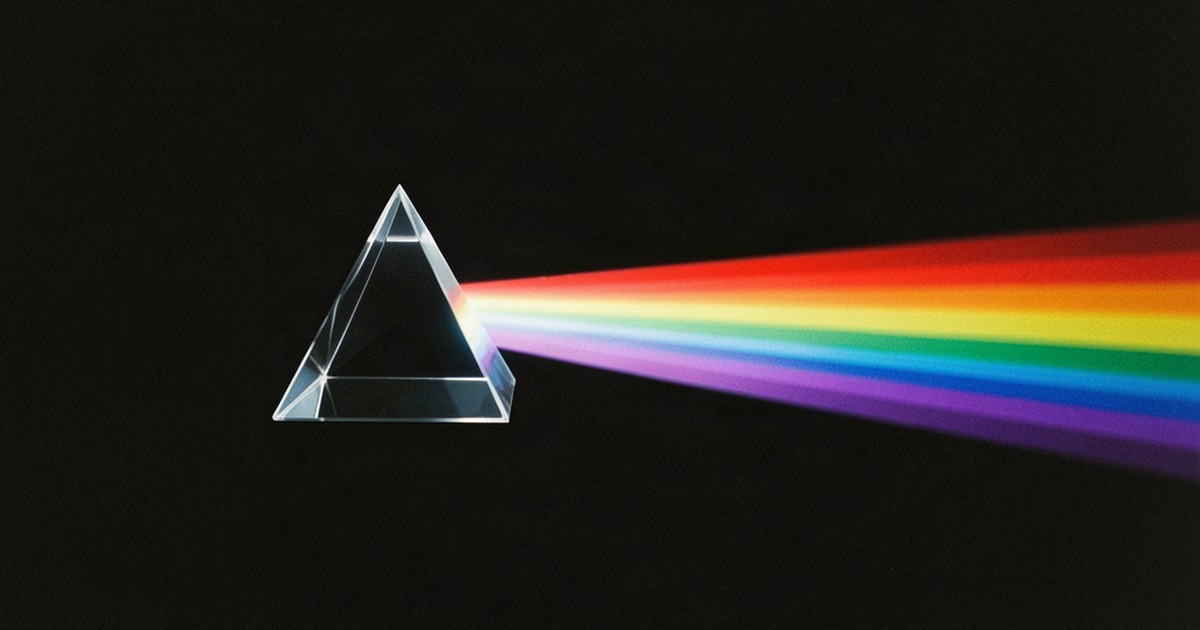
No band has been more dependent on its designers than Pink Floyd. The music was always self-contained — you can fall into Dark Side with your eyes shut — but the look of the band was someone else's job, and over twenty-seven years it produced the single most recognisable record sleeve ever printed, plus a cow, a flying pig, and a man set on fire.
Here's the list of the best Pink Floyd covers ever, ranked from most to least iconic.
1. The Dark Side of the Moon (1973)
 The Dark Side of the MoonPink Floyd · 1973
A triangular prism splitting white light into a spectrum on black. No band name, no title, no photography — just the cleanest idea anyone has ever had about what an album cover can be. It's been in print for over fifty years, it's on a billion t-shirts, and you can identify it from a single sliver of colour. There isn't a close second.
2. The Wall (1979)
 The WallPink Floyd · 1979
A plain white brick wall. That's it. After years of ever-more-elaborate Hipgnosis imagery, the band went as minimal as possible and produced the most starkly theatrical sleeve of their career — one that's still recognisable as a single white square from across a room.
3. Wish You Were Here (1975)
 Wish You Were HerePink Floyd · 1975
Two men shaking hands, one of them on fire. It's a comment on the music industry, on absence, on Syd Barrett — and it was shot for real, with a stuntman in a flame-retardant suit. The sleeve version burned on one side; the record about absence sold millions.
4. Animals (1977)
 AnimalsPink Floyd · 1977
Battersea Power Station, a pink sky, and a forty-foot inflatable pig floating between the chimneys. The pig broke loose during the shoot and drifted into Heathrow's flight path — which, for an album about Orwell and capitalism, was about the most on-brand thing that could have happened.
5. The Division Bell (1994)
 The Division BellPink Floyd · 1994
Two colossal metal heads facing each other in a field, a third profile forming in the gap between them. The last proper Floyd cover is also one of the most quietly clever — look at the space between the faces and a third appears.
6. Atom Heart Mother (1970)
 Atom Heart MotherPink Floyd · 1970
A cow. Just a cow, photographed in a field, no band name, no title. The most deliberately anti-commercial sleeve of its era — the band were so sick of being marketed that they put livestock on the cover and dared the label to complain.
7. Meddle (1971)
 MeddlePink Floyd · 1971
An ear underwater, caught mid-ripple. Abstract and beautiful, but it gives you almost nothing to hold onto — which is roughly the opposite of the sleeve that came two years later.
8. The Piper at the Gates of Dawn (1967)
 The Piper at the Gates of DawnPink Floyd · 1967
A kaleidoscopic portrait shot through a prism lens. As a document of the Barrett era it's perfect — warm, warped, and slightly out of focus — but it's an artefact of its moment rather than a timeless image.
9. A Saucerful of Secrets (1968)
 A Saucerful of SecretsPink Floyd · 1968
A comic-book psychedelia collage, the first of many Hipgnosis sleeves for the band. It's the sound of a group between Syd Barrett and whatever came next — colourful, a little lost, and very 1968.
10. The Final Cut (1983)
 The Final CutPink Floyd · 1983
Four poppy-red military ribbons on a field of medals. It's actually a Wall outtake — the same Gerald Scarfe visual language, repurposed for a record that plays like the last page of that album's story. Thin on its own terms, and it knows it.
11. A Momentary Lapse of Reason (1987)
 A Momentary Lapse of ReasonPink Floyd · 1987
Seven hundred hospital beds on a Devon beach, arranged in rows. The image is striking in isolation, but it belongs to an album that sounds like a band trying to remember what it was — and the sleeve has the same faint air of a reunion photo nobody quite wanted.
The most recognisable band in rock
What makes the Floyd discography unique is that the covers don't share a style so much as a confidence: the band let their designers run loose, and the designers — Storm Thorgerson, George Hardie, Aubrey Powell, Gerald Scarfe — kept finding one clean, singular image per record. Cow. Pig. Prism. Wall.
That's the test for a great sleeve, and it's also the test for the game: how few tiles do you need before you name it? See how quickly the prism gives itself away in today's VinylPeek, or browse the full Pink Floyd archive.