The best album covers of the 1970s
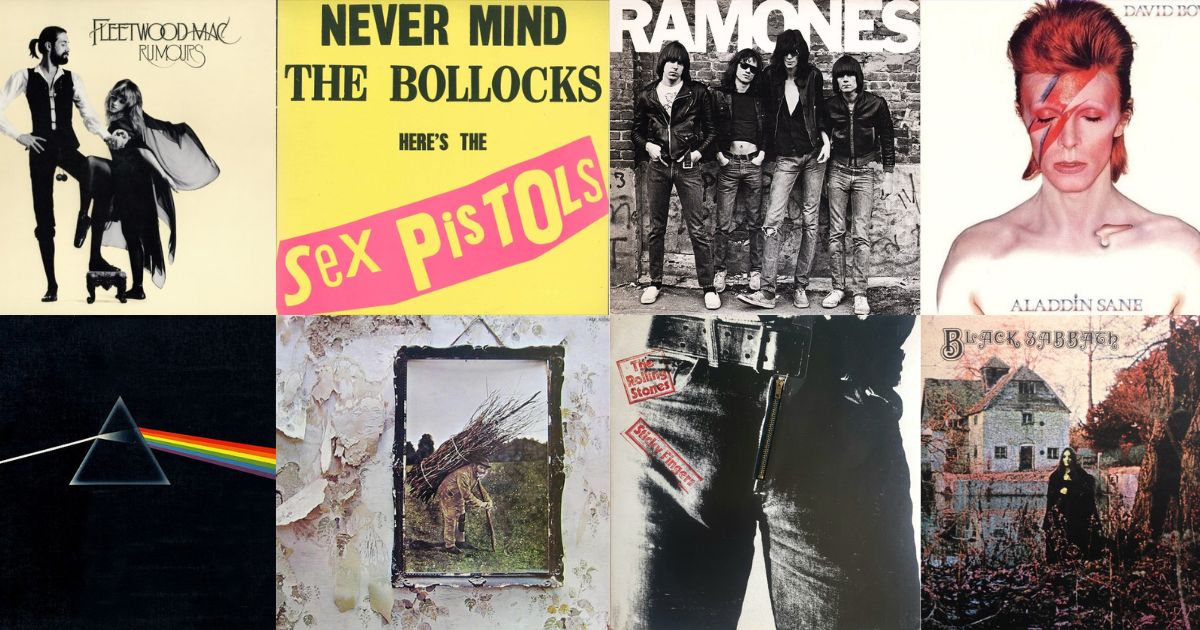
If you had to pick one decade as the high-water mark of album cover design, it isn't close. The 1970s had the budgets, the twelve-inch canvas, and — crucially — a generation of designers who treated a record sleeve as a serious brief rather than a place to print the band's photograph.
Here are fifteen from the era, and what each one gets right.
1. Pink Floyd — The Dark Side of the Moon (1973)
 The Dark Side of the MoonPink Floyd · 1973
A prism, a beam, a spectrum, pure black. No band name, no title. It is the most efficient piece of graphic design in popular music, and the reason is restraint: everything that could have been added was left off.
2. David Bowie — Aladdin Sane (1973)
 Aladdin SaneDavid Bowie · 1973
The lightning bolt across the face. A portrait turned into a logo — you can draw it from memory, which is the highest compliment a cover can earn.
3. The Rolling Stones — Sticky Fingers (1971)
 Sticky FingersThe Rolling Stones · 1971
A close crop of a pair of jeans, with a real working zip on the original pressing. A sleeve you had to touch, at a moment when nobody else was thinking about the object in your hands.
4. Led Zeppelin — Houses of the Holy (1973)
 Houses of the HolyLed Zeppelin · 1973
Children climbing an alien basalt causeway under an orange sky. Uncanny rather than pretty, and again with no text on the front.
5. Pink Floyd — Wish You Were Here (1975)
 Wish You Were HerePink Floyd · 1975
Two businessmen shaking hands, one of them on fire, in a bare studio backlot. The joke is that nobody reacts. It was shot for real rather than faked in post, which is why it still unsettles.
6. Fleetwood Mac — Rumours (1977)
 RumoursFleetwood Mac · 1977
Staged like a tarot card and lit like a stage play. Hard to describe from memory, impossible to mistake once you see it — a recognition cover rather than a recall one.
7. Patti Smith — Horses (1975)
 HorsesPatti Smith · 1975
A black-and-white portrait, white shirt, jacket over the shoulder. Robert Mapplethorpe's photograph refuses every convention of how a woman was pictured on a record sleeve in 1975, and it still looks modern.
8. Blondie — Parallel Lines (1978)
 Parallel LinesBlondie · 1978
Black and white vertical stripes with the band arranged against them. The stripes do the identifying — you can crop this to a corner and still name it.
9. The Clash — London Calling (1979)
 London CallingThe Clash · 1979
A bass being destroyed on stage, in grainy monochrome, with pink and green lettering lifted wholesale from Elvis Presley's debut. A cover about lineage as much as violence.
10. Joy Division — Unknown Pleasures (1979)
 Unknown PleasuresJoy Division · 1979
White stacked waveforms on black. No band name, no title, no colour. Possibly the most reproduced graphic in music, and identifiable from four or five lines of it.
11. Ramones — Ramones (1976)
 RamonesRamones · 1976
Four men against a brick wall in leather jackets. It cost almost nothing and defined how a punk band was supposed to look for the next fifty years.
12. Pink Floyd — Animals (1977)
 AnimalsPink Floyd · 1977
An inflatable pig over Battersea Power Station. An industrial building as album art, shot on location, with the surrealism kept to exactly one element.
13. Steely Dan — Aja (1977)
 AjaSteely Dan · 1977
A tight, cool portrait in shadow. Where most of this list shouts, Aja is deliberately quiet — it looks like the record sounds, which is a rarer achievement than it seems.
14. Rainbow — Rising (1976)
 RisingRainbow · 1976
A giant fist rising out of the sea to grasp a rainbow. Fantasy illustration was everywhere in seventies hard rock; this is the composition that survived, because there is one enormous form and nothing competing with it.
15. Black Sabbath — Sabbath Bloody Sabbath (1973)
 Sabbath Bloody SabbathBlack Sabbath · 1973
A painted deathbed scene in sickly greens and reds. Dense and detailed, and identifiable by palette alone — you know it from a patch of the background.
What the decade got right
Three things, mostly.
The canvas was twelve inches square and people looked at it while the record played. A sleeve could reward a second and third look, so designers built in detail that a thumbnail would waste.
Type was optional. Look at how many of these have no words on the front at all. That confidence — that the image alone will carry the record — is almost extinct now, because a cover has to work at 200 pixels in a streaming app.
Illustration was normal. Photography dominates modern sleeves; the seventies were as likely to commission a painting, and paintings age differently to photographs.
Browse the whole decade in the 1970s archive, or see how well you actually know these — today's VinylPeek hides a cover behind 64 tiles and asks you to name it from as little as possible.